In this article I’m going to show you how to get a copyright application, fill it out, determine how much to pay, and exactly how to send your application and books into the Copyright Office. This is not a difficult process, but since you’re dealing with your creative work and the government at the same time, it pays to be cautious and do it properly.
One of the most common questions I hear from self-publishers hasn’t changed over the years: “How do I copyright my book?” Authors are concerned that someone might appropriate the book on which they’ve worked so long and hard.
I usually give them the 5 minute guide to copyright and advise them to wait until their book is back from the printer to register the copyright. Of course, we’ve made sure we have an accurate and complete copyright page in the book to begin with.
But now, book in hand and still a sparkle in the eye, you are ready to register your copyright. Let’s get started.
Visiting the Copyright Office—Online, That Is
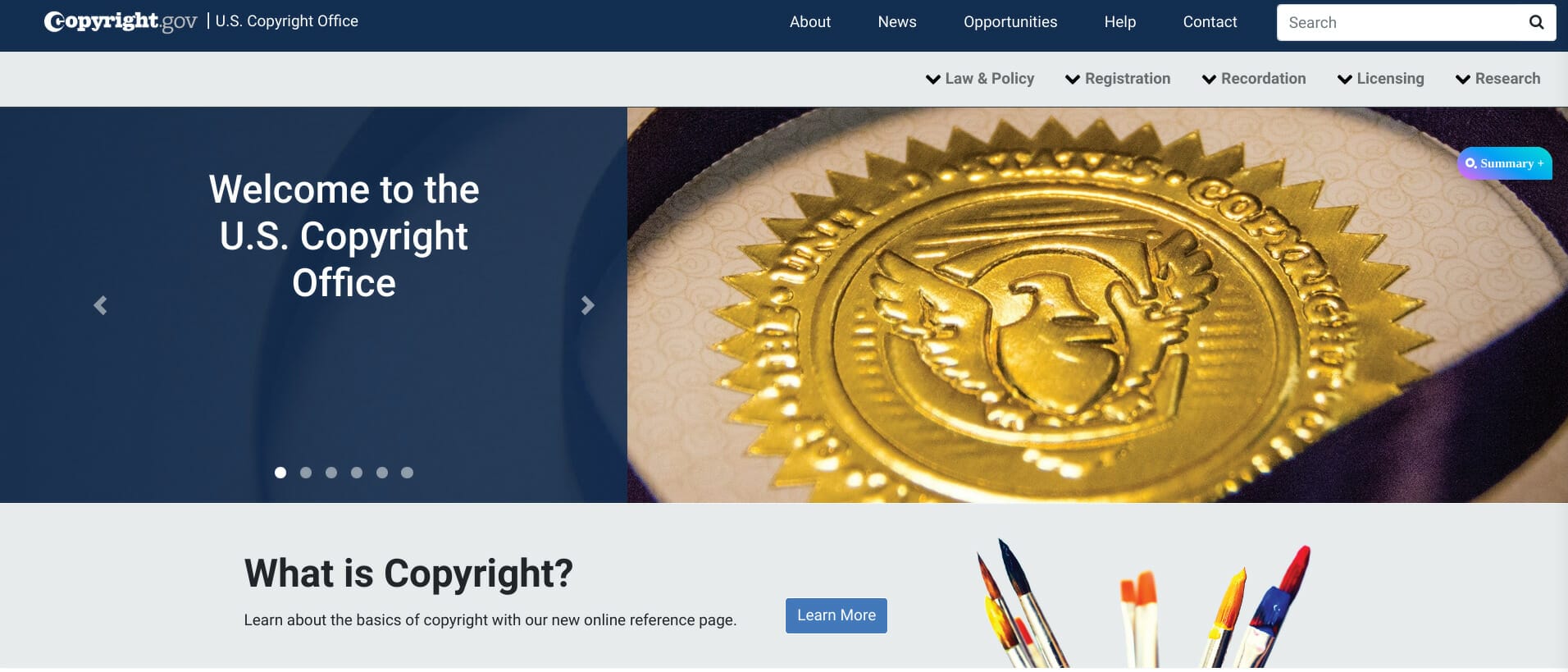
The Copyright Office, a branch of the Library of Congress, is located in the James Madison Memorial Building in Washington, D.C. However, we’re going to their online location at http://www.copyright.gov/
Here’s what you’ll find when you get there:
Copyright Registration Basics
You will need three elements to complete your registration:
- A completed copyright application,
- A (nonrefundable) filing fee, and
- A (nonreturnable) deposit, which means a copy or copies of your book
There are also three different ways to register your copyright:
- Online Registration—This is done through the electronic Copyright Office (eCO). The Copyright Office recommends this method as the preferred way to register books. They cite these advantages:
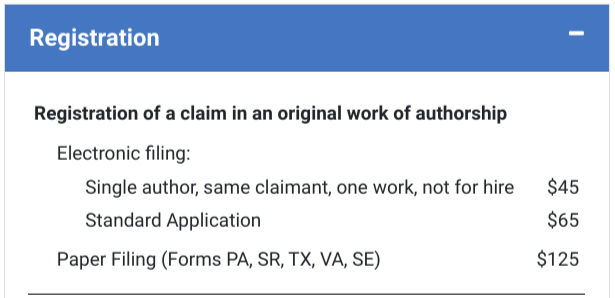
- A lower filing fee ($35 as opposed to $50 or $65 for the other methods)
- Online tracking of the status of your copyright application,
- Faster processing time and secure payment.
- Option to upload your book or mail it in.
- Registration with Fill-In Form CO—This option uses the fill-in Form CO. This uses the technology of Adobe PDF forms to create scannable barcodes on the electronic form depending on your input. When the form is printed out and sent to the Copyright Office, they are able to scan the forms and can consequently process these applications much faster than forms that must go through data entry first.
The cost of this filing form is $50, and you’ll need to have Adobe Acrobat Reader 8.0 or better on your computer. If you don’t have it you can use the link to get a copy for free.
How to do it: Download the Form CO by clicking through this link, and follow the instructions. At the end you’ll print out the form, which should have barcodes that look like this and which are clear, not wrinkled or smudged. You’ll then mail it with your check and 2 copies of your book to the address indicated on the form. - You must submit the original 2D barcode form only. Do not send a photocopy.
- Never alter the form by hand after you print it out. The information you enter is stored in the barcodes on the form.
- Both single- and double-sided printing are acceptable.
- To achieve best results, use a laser printer. Inkjet printer copies require enlarging if you use the shrink-to-fit-page option. Dot-matrix printer copies are not acceptable.
- Inspect your printed form to confirm that 2D barcodes appear clear and free of any distortions, smudges, or fading. If such problems appear and cannot be corrected after checking your printer, do not submit the form.
- Registration with Paper Forms—The traditional method, which the Copyright Office is planning to phase out altogether. This uses Form TX and charges a fee of $65. However, in an apparent effort to discourage the use of these paper forms, the Copyright Office does not even offer a download of these forms from its website. Instead, you must fill out a Request for Copyright Forms by Mail to have a staffer at the CO mail you a copy of the form.
How to do it: Click the link above to request a copy of form TX. Fill out the form and mail it with your fee of $65 along with copies of your book to the address indicated on the form.
How long it takes: “Most of those who file on these forms should receive a certificate within 22 months of submission. Many will receive their certificates earlier.”
How to do it: Use this link to go to the electronic Copyright Office and register for an account to get started. You’ll then follow the prompts to register your book.
How long it takes: “Most online filers should receive a certificate within nine months. Many will receive their certificates earlier.”
How long it takes: “Most of those who file on these forms should receive a certificate within 22 months of submission. Many will receive their certificates earlier.”
The Copyright Office also offers the following important guidelines for using fill-in form CO:
Keep in mind when using any of these methods that no matter how long it takes to get your copyright certificate, your copyright registration is effective the date that the Copyright Office receives the complete submission, whatever form it takes.
A Digression and a Visit from Pete Masterson
I noticed while navigating the Copyright Office website that there was a strange notice appearing here and there. It said: Please note that our mail service is severely disrupted. I had read about serious backlogs at the Copyright Office, so I used the terrific Yahoo Self-Publishing discussion list to find out what others knew about the situation. Here is the response I received from Pete Masterson. Pete is a longtime book designer, currently the president of BAIPA (Bay Area Independent Publishers Association) and the author of Book Design and Production for Authors and Publishers. With his permission, I reprint his response here:
An interesting historical note. Shortly after the Arab terrorists attacked us on 9/11, there were various threats and attacks including the Anthrax attacks and scares. For security reasons, the copyright office had all incoming packages sequestered somewhere by the Postal Service. (In an old salt mine or cavern, I think) It took ages for the Postal Service to get around to checking the packages and processing them, and finally delivering them to the copyright office.
The Postal Service had not bothered stamping “received” dates on the parcels, or even tossing them in bags marked with the “received” dates. Or properly organizing them by dates received in any way. Many of the parcels were sent with stamps, and many cancelations were illegible.
Thus, there were real issues with the effective dates of copyright registrations, and many registrants were unfortunately stripped of their ability to sue infringers. The copyright office eventually used some pretty sloppy “Kentucky Windage” to guesstimate effective dates for many thousands of registrations, by adding a given number of days to the mailing date and figuring THAT would be the date when the thing SHOULD have been delivered. The guesstimated effective dates were based on legible postmarks. For those with no postmarks . . . tough luck; THEIR effective date was as much as a year or more later than the legitimate effective date would have been.
Having been warned – by both a Postal Service and copyright office employee – years before that, my own registrations were not affected much.
I haven’t used UPS to send in registrations.
Not an answer to the question — but a side issue. If you send a package to the Copyright Office (or any Federal agency), use a courier service — either FedEx or UPS. (Doesn’t matter if you use a ground or air service.) All packages via the USPS are irradiated (to kill biological threats) and the treatment is damaging to many books, especially those printed as digital color copies. More importantly, the service adds a significant delay to the process.
FedEX and UPS packages are not irradiated (because you can’t anonymously send packages as you can via USPS) and are not delayed.
A publisher I know sent off a copy of a book to a friend who works for a Federal Agency to his business address. Since it was a package, the government routed it through the irradiation process.
During irradiation, the book is exposed to ionizing radiation at a level that will kill all biologic organisms. It also, as a side effect, heats the target of the radiation. The result for a moderate sized (150 page) book printed in digital full color was to melt the toner, causing the book to become one solid mass — and the edges of many pages showed signs of scorching.
The book, as received, was completely unreadable and unusable.
In this case, the book was a gift to a friend. Think of how damaging to your reputation it could be if that was what was received when submitting a book for consideration by a Federal Agency!
Okay, back to work.
Q and A with the Copyright Office
Last, I’m going to reprint here some of the useful questions and answers from the Copyright Office website. I’ve found that authors who are thinking about self-publishing have enormous trepidation when it comes to copyright, and are subject to all kinds of superstitions and misinformation. The cure is accurate information. Here it is, from “the horse’s mouth.”
Do I have to send in my work? Do I get it back?
Yes, you must send the required copy or copies of the work to be registered. Your copies will not be returned. If you register online using eCO eService, you may attach an electronic copy of your deposit. However, even if you register online, if the Library of Congress requires a hard-copy deposit of your work, you must send what the Library defines as the “best edition” of your work. … Upon their deposit in the Copyright Office, … all copies and identifying material, including those deposited in connection with claims that have been refused registration, are the property of the U.S. government.
Will my deposit be damaged by security measures in place on Capitol Hill?
To avoid damage to your hard-copy deposit caused by necessary security measures, package the following items in boxes rather than envelopes for mailing to the Copyright Office:
- electronic media such as audiocassettes, videocassettes, CDs, and DVDs
- microform
- photographs
- slick advertisements, color photocopies, and other print items
May I register more than one work on the same application? Where do I list the titles?
You may register unpublished works as a collection on one application with one title for the entire collection if certain conditions are met. It is not necessary to list the individual titles in your collection. Published works may only be registered as a collection if they were actually first published as a collection and if other requirements have been met. See Circular 1, Copyright Basics, section “Registration Procedures.”
Do I have to use my real name on the form? Can I use a stage name or a pen name?
There is no legal requirement that the author be identified by his or her real name on the application form. For further information, see FL 101, Pseudonyms. If filing under a fictitious name, check the “Pseudonymous” box when giving information about the authors.
Will my personal information be available to the public?
Yes. Please be aware that when you register your claim to a copyright in a work with the U.S. Copyright Office, you are making a public record. All the information you provide on your copyright registration is available to the public and will be available on the Internet.
Can I submit my manuscript on a computer disk?
No. Floppy disks and other removal media such as Zip disks, except for CD-ROMs, are not acceptable. Therefore, the Copyright Office still generally requires a printed copy or audio recording of the work for deposit. However, if you register online using eCO eService, you may attach an electronic copy of your deposit. However, even if you register online, if the Library of Congress requires a hard-copy deposit of your work, you must send what the Library defines as the “best edition” of your work. For further information, see Circular 7b, Best Edition of Published Copyrighted Works for the Collection of the Library of Congress, and Circular 7d, Mandatory Deposit of Copies or Phonorecords for the Library of Congress.
Can I submit a CD-ROM of my work?
Yes. The deposit requirement consists of the best edition of the CD-ROM package of any work, including the accompanying operating software, instruction manual, and a printed version, if included in the package.
Does my work have to be published to be protected?
Publication is not necessary for copyright protection.
How much do I have to change in my own work to make a new claim of copyright?
You may make a new claim in your work if the changes are substantial and creative, something more than just editorial changes or minor changes. This would qualify as a new derivative work. For instance, simply making spelling corrections throughout a work does not warrant a new registration, but adding an additional chapter would. See Circular 14, Copyright Registration for Derivative Works, for further information.
Do you have special mailing requirements?
If you register online, you may attach an electronic copy of your deposit unless a hard-copy deposit is required under the “Best Edition” requirements of the Library of Congress. See Circular 7b. If you file using a paper application, our only requirement is that all three elements—the application, the copy or copies of the work together with the shipping slip printed when you fill out Form CO online, and the filing fee—be sent in the same package. Please limit any individual box to 20 pounds. Many people send their material to us by certified mail, with a return receipt request, but this is not required.
A Final Word on Copyright
Well, there you have it. In practice, this is not a complicated process. Most people will simply log onto the Copyright Office website, create an account and fill out the online form. It doesn’t take long and it’s not very intimidating. In the interest of being thorough, I like to give you all the options so you can decide which suits you best.
But don’t neglect this important task. Although your book will still be copyrighted, if you don’t send in the forms and the filing fee, your copyright will not be registered. And it’s the registration that will be critical if there’s any dispute about your copyright in the future.
Takeaway: The simplest way to copyright your book is through the online facility provided by the Copyright Office. Be aware of your choices in registering your copywrite, but don’t fail to get it done.


{ 4 comments… read them below or add one }
Just one of the many things that happened to escape my mind when thinking about the writing process. I do however have a few questions though.
Should someone who is attempting to have their book picked up by a publisher go through this process before submitting it to an agency? I’m not sure what the parameters for ownership and copyrighting are when dealing with a large publisher and I’m assuming this is for self publishing needs primarily.
Also, in either case, “the best edition” – does that apply to the manuscript alone? Let’s say I have a “finalized version” of it, but the publisher might ask that I add or remove some details, would it need to be resubmitted? Or even if I just decide I had to change something one night, no one has ever seen it, and out of the blue I opt to change a third of the book and introduce a new character. An extreme scenario and one that would best be avoided, but if one were had to make a large change would both copies be added in the record or would it apply as a totally new work?
Sorry for the very basic, newbie questions.
Brian,
You don’t need to register the copyright on your book until it’s been printed. You owned the copyright when you wrote the book, this is well known by publishers, agents, and anyone who deals with books.
The “best edition” refers to the best “printed” edition, for instance if you printed both hardcovers and softcovers, “best edition” would be the hardcover. It all relates to printed books, since that is what is used when registering copyright.
Ask any questions you like, Brian, I’ll try to help out, and thanks for stopping by.
Dear Joel, when you file copyright for a novel online and pay the fee, do you send your printed work through the mail, right after the application and fee are finished? If you wait and send your work in after it is printed,
can you still put the copyright date on your novel before sending it in to the publisher? I work with InstantPublisher.
Thank you, Suzie Birchmier
Suzie, most books can now be uploaded directly to the Library of Congress when you use the online Copyright registration system. This works for most people because they already have a PDF file of the book. You print the copyright notice along with the date in the book when it’s printed, and if you are sending in physical books, you send the printed books along with the paperwork. Thanks for stopping by!
{ 2 trackbacks }