Book cover design is an important part of publishing a book, but there are so many options to consider. Do you want to publish a paperback or hardcover book? Do you want to use a casewrap cover or have dust jackets? What are the pros and cons of each?
This post continues the Book Construction Blueprint, a series of posts providing reliable guidance to anyone taking on the construction of a book that must conform to generally-accepted practice.
We’ve already looked at the parts of a book, book pagination, the copyright page, the use of chapters and subheads, and the elements found on the book page. Now we turn to our final topic: covers and dust jackets of books and their function.
Categories of Book Covers
All books by their nature have a cover. We categorize book covers into hardcover and softcover, but they are better referred to as casebound and paperbound. A trade hardcover book is composed of a bookblock (the interior pages taken together) glued, or sewn and glued, into a case, constructed of laminated cardboard and covered with cloth or paper.
Instead of gluing on a cover as is done for a paperback, for a hardcover book the bookblock is attached to a premade case. Here’s how they do it in three steps:
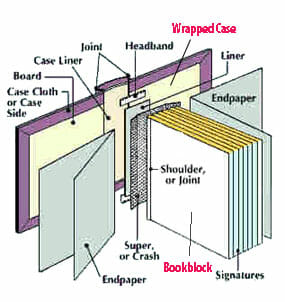
- Three pieces of stiff board, called binder’s board, are covered with something, like paper, cloth, cloth treated so that it can be printed like paper, leather, or anything else you can cover the boards with.
- An extra, folded sheet of paper the same size as the book, is attached to the front and back of the bookblock. These are the endpapers.
- The flyleaves and spine are glued to the case, creating an integrated hardcovered book.
Cloth cases are frequently stamped with the title, author’s name, and a publisher’s name or logo, and then covered by dust jackets. Alternatively, paper cases are often printed and laminated before being wrapped on the cardboard and consequently don’t need dust jackets. Special impregnated cloth can also be used for this purpose, for instance, on textbooks.
Casebound books—a specific type of hardcover book—are sometimes issued with paper covers, or case wraps that are printed to identify them and also to act as advertisements for the book, establishing a mood or carrying commercial messages and endorsement designed to appeal to potential buyers. These books are sometimes known as case-wrapped.
A feature unique to casebound books is the use of endsheets, a four-page sheet of paper at both the front and back that helps connect the bookblock to the case, while covering the edges of the case wrap for a neater and more durable book.

Paper Covers
Printed heavy weight paper (also referred to as cardstock) is used for the majority of softcover books. The bookblock is glued into the printed and scored case, then the entire book is trimmed on three sides to the final trim size. A book bound in this way is said to be perfect bound.
A variety of finishes can be used on the paper covers before binding, including:
- foil stamping
- embossing (creating raised areas)
- debossing (creating sunken areas)
- varnishing
- laminating with either liquid quick-setting plastic laminates, or with film that is then affixed to the cover with heat and pressure. Film lamination affords the best protection, but may cause the cover to warp in conditions of changing humidity.
Paper used for softcover books is usually uncoated on the inside to create a more porous surface for the glue to adhere to.
Dust Jackets
In the typical commercial hardcover, the boards are covered with cloth that has been stamped on the spine with the title, author, and publisher imprints, and occasionally also on the front of the book. Sometimes the covers are part cloth and part paper. Without their artistic or commercial dust jackets, they would look very bland.
The dust jacket—which sets the mood for the book, positions it within its genre, or provides hard-hitting sales copy—both complements and promotes the book. This same job is done by the paper covers on softbound books. And it can also be done by casewraps, where the paper used to wrap the case is printed.
Casewraps
Casewrap hardcovers can be a deeply integrated expression of the book within. The designer can use the materials at her disposal in printed and stamped papers, with all the finish we’re used to in covers and jackets, but applied to the wrap attached to the book itself.
This type of binding is common where dust jackets are impractical. Other uses for casewraps:
- Manuals and reference books, where a jacket is unnecessary and cumbersome.
- Cookbooks. I learned to cook with a casewrap edition of The Joy of Cooking, and it had a finish you could wipe with a sponge. Wonderful.
- Textbooks, which need to be durable and economical.
- Poetry books are lovely as casewraps. For many years a series of books from Peter Pauper Press were issued with pattern-printed paper casewraps, and they’ve become classics.
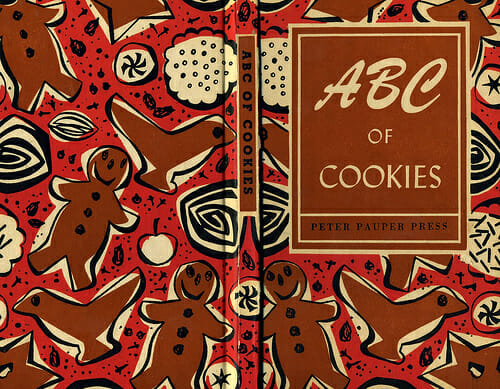
Casewraps are also less expensive than cloth-covered, stamped cases with dust jackets printed separately. Unless you are trying to do a major launch of a book into the retail book distribution channel, it may be hard to justify the expense of a traditional, jacketed hardcover. The upcharge from digital printers like Lightning Source puts hardcovers well out of reach of normal distribution discounts.
For instance, a 200-page 6″ x 9″ softcover costs $4.81 at Lightning Source, already high when you take into account the 55% to 65% discounts you will need to give for distribution. For a casewrap hardcover, add a little over $5.00 each, and for jacketed hardcovers, add $7.14 each. You’ll quickly price yourself out of the market when competing against books from offset printers turning out thousands of copies at once.
Use casewraps for the specialty books noted above, since it’s easier to command a higher price for these books.
Putting it All Together
This completes our tour through the various parts of the typical trade book, and the logic behind the way they are built. Armed with this information as a reference, you can be assured of constructing a book that conforms to standard practice, and for that reason can stand the test of time.
Editor’s note: This post was originally written and published by Joel Friendlander in 2009 and has been updated to reflect current trends in the world of book design and publishing.