ISBN 101 For Self-Publishers

by Joel Friedlander on November 19, 2010

Print Friendly and PDF   Share
Post image for ISBN 101 For Self-Publishers

One of the parts of book publishing that seems to confound newcomers to the field is the purpose and use of the International Standard Book Number (ISBN). Usually the ISBN appears to be the same thing as the ubiquitous Bookland EAN scannable barcode that graces the back covers of almost all books printed today.

Not only that, but since the rise of companies that perform publishing services for authors, there has been even more confusion about whether you need to own your own ISBN, whether free ISBNs from these companies are “just as good” as getting your own ISBN, and if it’s a good idea to buy ISBNs from re-sellers who offer lower prices for a single number.

Let’s review the basics of this unique identifier and explain what is so important about it, how it benefits self-publishers, and when you can safely forget about it.

Created to Solve Real-World Problems

ISBN was created as a stock-keeping identifier. Originating in the United Kingdom, the concept of a unique identifier for each version of a published book became an international standard in the 1970s.

It was created to solve a real-world problem, and it worked well. The problem was that in the pre-internet age, it was often very difficult to identify a particular book, and more so when a searcher did not have the full title, author and edition information at hand. That’s usually the case when I go searching for a book.

How would you know whether the book you are looking for is the right one? Book titles are not exclusive or protected by copyright, and it’s not unusual for several different books to have the same title. And similar titles will quickly expand the number of possibilities. Add to this the necessity of knowing which edition you are looking for—hardcover, paperback, second edition—and it’s easy to see how identification mistakes are easy to make.

With the use of the unique identifier, one that is attached to each physical format of a book, this problem is basically solved. Every title, and every different edition or format has its own unique number for tracking and search purposes.

Coincidentally the ISBN came into use at the same time that computers were becoming common, and the two were meant for each other. It’s now possible to simply enter an ISBN into a Google search bar to get all the information you need on a particular title.

Who Doesn’t Need an ISBN?

Because the ISBN is used as a basic identifier throughout the book distribution system, any book that is intended to be sold through retail channels will need to have this identifier.

There’s no absolute need for books printed for private use, or for a closed distribution to have ISBN assigned. These might include:

  • Workbooks distributed at seminars
  • Company training manuals for internal use
  • Family histories, recipe collections or other “personal” publishing projects
  • Books that will be used only as premiums, incentives or giveaways

However even publishers of these types of books might make use of this identifier if they plan to someday convert their publication to a commercial use.

Self-Publishing Hits the Scene

You may not realize this, but for many years Bowker issued ISBNs to book publishers for a nominal administrative fee.

But once the self-publishing field began to expand in response to new digital printing technology, Bowker made the process of acquiring ISBNs easier, and a lot more expensive. Now ISBNs are sold like any other commodity by Bowker and a few authorized re-sellers. And to accommodate the needs of these self-publishers, they made individual numbers available for the first time.

However, the price Bowker set for individual identifiers (currently $125) has shocked many new publishers. (You can read an explanation of why the cost is so high in the interview I did with Andy Weissberg).

But keep in mind that it’s rarely a good idea to buy just one ISBN. If you intend to issue your book as both a printed book and an ebook, you will need two ISBNs right from the start, and the cost of buying two individual numbers is the same as purchasing ten numbers (currently $250).

In addition, Bowker is actually registering your publishing company when they issue you your numbers, not your individual books. This is a key step for many self-publishers and that’s a pretty good reason to get an ISBN as well.

The Problem of the “Free” ISBN

In order to mitigate the cost and the bother of registering your company yourself, author services companies started offering “free” identifiers to clients. How were they able to do this?

Bowker’s pricing for these numbers has huge volume discounts, that’s how. For $5,000 you can acquire 5,000 ISBNs. That’s only $1 each, a price at which it’s easy to give them away, saving individual authors quite a heap of money.

And many authors have made use of this savings. You are a good candidate for a free number if:

  • You intend to publish only one book
  • You have no interest in starting a “publishing company”
  • You’re on a very tight budget

But it’s not the right solution for everyone, because ISBN performs many functions for self-publishers.

Know Your Retailers

People who help authors get started in publishing often remind them that this is a business, and should be approached as such. You are manufacturing a product intended for retail sales. In this scenario it’s important for you to know the policies of the retailers who will be selling your book.

For instance, here’s what Smashwords, the big distributor of ebooks, says about ISBN usage:

Smashwords retailers such as Apple and Sony will not accept your Smashwords book unless you have a unique e-ISBN. It is the primary digital identification number that many major online retailers use to track and catalog your books, and to report your sales back to Smashwords.

(Editor’s note: Everything at Smashwords is an e-book, but there really isn’t such a thing as an “e-ISBN”. They are all just plain old ISBNs.)

The Many Roles of a 13-Digit Number

Smashwords also points out one of the other uses of this handy number. In fact there are three main ways these numbers can be of use:

  1. Stock keeping, for inventory purposes
  2. item identification to differentiate similar editions
  3. Metadata

It’s this last benefit of ISBN you should think about when deciding whether to use them, and whether you want to go to the expense of buying your own numbers, or to accept the “free” version.

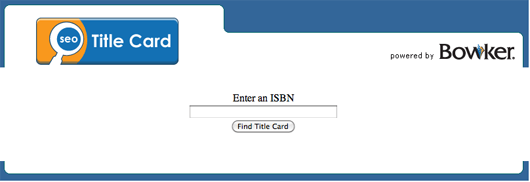
SEO Title Card - Metadata for self publishers

2 Reasons to Own Your Own ISBNs

Most of the self-publishers I’ve worked with are setting up their own publishing companies and funding their project in the expectation of becoming profitable. In every case I’ve advised them to buy their own ISBNs. Here’s why:

  1. The ISBN contains within it a “publisher identifier.” This enables anyone to locate the pubisher of any particular book or edition. If you use a “free” ISBN from an author services company or a subsidy publisher, that company will be identified in bibliographic databases as the publisher.
  2. Owning your own ISBNs gives you the ability to control the bibligraphic record for your book. This is an important part of your book’s metadata, and is a key component in your book being discoverable by online searchers. This has a powerful influence on your efforts to attract search engine traffic to your title.

Now there’s no reason you can’t publish your books with a “free” ISBN from a reputable company, like CreateSpace. Having their identifier on your book doesn’t have anything to do with the ownership or copyright on your work, you still have complete control over your own content.

And you can be very successful this way, too. April Hamilton originally published Indie Author and several other books that way, and enjoyed great success. But like others who have committed to making publishing their business, she has said she would now buy her own ISBNs.

Part of the reason, as Hamilton explains, is the changing marketplace:

Distribution options offered by print and digital publishing service providers increasingly require that the author/imprint be the registered owner of the ISBN.

Echoing this is this explanation from the Smashwords ISBN guide:

An ISBN helps make your book more discoverable to readers and other book buyers. The ISBN gains you free inclusion in Books in Print, the world’s largest catalog of books, which is licensed to all major search engines and thousands of bookstores and libraries. Your ISBN record will also receive a free online listing at the online Books in Print bibliographic database that’s available on the open Web at http://seo.bowker.com.

Takeaway: If you plan to sell retail you’ll need to use ISBN. For strictly private publications, you may not need it at all. And if you plan to continue in publishing, buy your own ISBN block from the start.

If you have questions about ISBNs or how to use them, please leave a note in the comments.

Resources

Bowker U.S. ISBN Agency site
Wikipedia entry on the International Standard Book Number
ISBNs Don’t Matter as Much as You Thought by Indie Author April Hamilton
About ISBNs from Smashwords
Twitter #ISBNhour discussion group link (moderated by @LJNDawson)
UK ISBN Information

TheBookDesigner Articles on ISBN
ISBNs for Self-Publishers: Answers to 20 of Your Questions
How to Create, Register and List Your New Publishing Company
Self-Publishing Basics: How to Read an ISBN

Print Friendly and PDF   Share

{ 46 comments… read them below or add one }

Michael N. Marcus November 19, 2010 at 4:33 am

>>any book that is intended to be sold through retail channels will need to have this identifier.<>The ISBN contains within it a “publisher identifier.” <<

A publisher may have several identifiers (a.k.a. "prefixes"). If you order blocks of ISBNs at different times you get different prefixes. I got 9816617 in 2008 and 9830572 in 2010. There is probably no disadvantage to having several prefixes, but it may bother anal retentive publishers.

Some ISBN tips:

(i) ISBNs are not returnable and are no supposed to be sold or transferred, so be sure that you will use them before you place an order.

(2) Make a list of your books and their ISBNs so you don't assign the same ISBN to several books.

(3) Bowker says that it can take up to 15 days to receive ISBNs and the company offers extra-cost faster processing. It's probably a waste of money. In 2008 it took two days with an extra fee. In September of this year, I got my numbers in a few minutes witout paying extra.

(4) ISBNs are provided free by the ISBN agencies in some countries, but not in the USA.

Michael N. Marcus
http://www.BookMakingBlog.blogspot.com
http://www.Self-Pub.info
– Create Better Books, with the Silver Sands Publishing Series: http://www.silversandsbooks.com/booksaboutpublishing.html
– "Stories I'd Tell My Children (but maybe not until they're adults)," http://www.amazon.com/dp/0981661750

Reply

Joel Friedlander November 19, 2010 at 7:53 am

As you suspect, there is no downside to having more than one “publisher identifier” since both will point to you as publisher. The problems come in when the publisher identifier points to an author services company as the publisher, leaving you as a self-published author without a publishing company, a bit of an oddity. Thanks for the tips.

Reply

Michael N. Marcus November 19, 2010 at 2:42 pm

I just learned of another potential problem when authors don’t own their ISBNs.

The IBPA Benjamin Franklin Awards are open to small and independent publishers. The rules say “The entity to which the ISBN was issued by R. R. Bowker is the publisher.”

An author who does not own the ISBN for a book she wants to enter must provide a letter of approval from the publisher to enter the contest on behalf of the publisher.

It’s possible that other awards programs have similar policies.

Reply

SonnyGoten February 7, 2012 at 11:43 am

You say in (4) that it is possible in some countries to get free ISBN. But is this only possible for those that are from that specific country or can others make use of this as well.

Reply

Joel Friedlander February 7, 2012 at 6:57 pm

No, you have to be a resident or a publisher located in the country. It would be pretty chaotic otherwise.

Reply

SonnyGoten February 9, 2012 at 6:26 am

So, even if I write in a language different than my own country’s, I still need to use the ISBN from my country? Say, for example, if I were French and I wanted to write in Japanese? I would still have to use a french ISBN?

Reply

Joel Friedlander February 9, 2012 at 1:40 pm

Sonny, it’s not about the language, but where the publisher is located that dictates where you get your ISBNs.

SonnyGoten February 12, 2012 at 4:31 am

I see. But what if two self-publishing authors of different countries decide to publish something they made together? Then which country should the ISBN be from? Or what if the publisher in question is web-based and prefers to keep an international image? Does he still need to use the ISBN from his home country? And what if the publishing author is an immigrant? Which country would he/she need to ask ISBN from? I know I may be asking too many difficult questions, and sorry if I do, I’m just trying to figure out how ISBN is working. Thank you for the answers you’ve given me. :-)

Reply

Joel Friedlander February 12, 2012 at 11:30 am

Sonny, you can keep asking but the answer is always going to be the same: the publisher is responsible for ISBNs, it has nothing to do with authors and the languages they speak. A publisher is a business and operates as a business entity. The country in which the publisher does business is where they will acquire the ISBNs.

R Thomas Berner November 19, 2010 at 5:55 am

Very clear explanation. Thank you, Joel.

Reply

R Thomas Berner November 19, 2010 at 5:58 am

Just remembered a question. I got an ISBN for a book and went online and found a software package that created ISBNs. Fortunately, I could use the trial version for free. But I was wondering if my Avery label software, which enables one to create a barcode for the zip code, doesn’t do the same thing. Avery converts five- and nine-digit codes into bar codes. Isn’t that the same thing as an ISBN. Numbers converted to a barcode?

Reply

Joel Friedlander November 19, 2010 at 7:55 am

Thomas, I’m assuming you mean software that creates bar codes. The ISBN is simply the number itself. There are a number of software packages for creating bar codes but be careful that the specific barcode you create is in the Bookland EAN format. Many book designers will provide a bar code free of charge if they are working on your project, and some printers provide them also. This is not the same as using an author-services company’s ISBN—the barcode is simply a scannable representation of the number.

Reply

Rima November 19, 2010 at 7:41 am

Joel – another fantastic and helpful article. I was just wondering if I should purchase an ISBN for my book, in the event it doesn’t get published traditionally, because I want to see it in print.

Reply

Joel Friedlander November 19, 2010 at 7:57 am

Rima, thanks. There’s no real reason to buy ISBNs until you decide whether you want to publish it yourself. There will be plenty of time to get ISBNs at that point and in the meantime you can avoid the expense. Thanks for reading.

Reply

Roemer McPhee November 19, 2010 at 1:04 pm

Joel, this question is tangential, about a self-publishing co. providing ISBNs.
What do you think of Author House?

RM

Reply

Joel Friedlander November 19, 2010 at 1:07 pm

Roemer,

I think there are better alternatives. Check out CreateSpace for one.

Reply

Mike Perry, Inkling Books November 19, 2010 at 2:23 pm

It’s at the low-quantity end where ISBN prices have risen enormously. In 2000, I picked up 1000 for Inkling Books for $600. Now that many costs $1000. It’s still a large increase, 67% more than the 2000 price in a time of low inflation, but not that outlandish.

It’s the low end where the increase has been outlandish and where Bowker’s scarce-concealed hostility to small publishers is most evident. I seem to remember ISBN’s costing about $4 each in quantities of ten or $40 total. Now it’s $250, a more than 600% increase.

It’s difficult to image that’s a result of any increase in processing costs. With Bowker, the customer does the data entry work. Bowker merely runs the servers and cashes the checks. Ten or ten thousand doesn’t make that much difference. And if you’d like a apt comparison, Internet web page assignments in quantities of one cost $10 or less, a tiny fraction of the $125 Bowker charges for a quantity of one. There’s no way prices have to be that hight.

Service at Bowker is also less than impressive. Most business give their clients a monthly statement. I’ve tried to get Bowker to create a script that would generate a PDF listing all assigned titles from their data and email it to their clients each month. That’d cost them almost nothing and would be far easier for clients to use than wading through data screen after data screen checking each title. No luck. If I don’t like the service Bowker provides, where can I go?

Sadly, Bowker has become a typical monopoly. Their prices are too high and their service is weak at best. I suspect it wouldn’t be that hard to given them some competition. I once tried to interest Google in that, but no one seems interested. Someone who once worked with Amazon’s databases told me that Bowker price rises aren’t the result of rising costs. They’re an effort to get the profits up, so those who own it can sell it for a handsome profit.

The sad thing is we shouldn’t even be using ISBNs for ebooks. A better scheme would replace ISBNs with something actually designed for the ebook market. ISBN is a 70s-era scheme for bar-coding physical books in an era when only large corporations owned computers. It’s woefully inadequate for the complexity and variety of digital books in the Internet age.

The new International Digital Document Code (IDDC) could, for instance, contain character groups that clearly identify an ebook’s content, format and DRM. As a customer I could look for a title I want using the content coding to locate identical content, the format coding to find the best price for the device I’m using, and the DRM coding to suit my preferences. With the sadly antiquated ISBN, none of that is in the number itself. Customers, many of them technically illiterate, have to somehow locate and fiddle around with any number of 13-digit number strings. Not good.

A note to the author. It’s OK to explain ISBNs to those who are new to publishing, as you’ve done, and you’ve done a good job of that. But we don’t have to keep using ISBNs any more than in the days of the Model T the new automobiles needed to include buggy whip holders. Any discussion of ISBNs should point out their many flaws and encourage the development of something better.

And it’s difficult to imaging how there could be anything that wouldn’t be better and cheaper than Bowker’s overpriced and woefully buggy-whip era ISBNs.

I got my ISBNs when the getting was cheap, so this isn’t an issue with me. But I feel sorry for those new to publishing who have to pay much, much more and to digital book customers who must contend with a numbering system that wasn’t designed for what they are buying.

Reply

Joel Friedlander November 22, 2010 at 4:50 pm

Mike, as you can tell from my article I remember the days when ISBNs were basically free, as they are in other countries, and you just had to pay a $30 “admin” fee to pay for the people who printed out the green bar paper in New Jersey.

It’s also interesting to compare the low end and high end of these prices. The 125-to-1 ratio is astonishing, and I can’t think of another product with that kind of volume pricing spread.

I haven’t kept up with the IDDC developments, but it sounds interesting.

With the way the market is right now, and the distrust of self-published books that persists, I continue to advise my self-publishing clients to use ISBN. Many retailers require it and there doesn’t seem to be any good reason for them to cripple their own sales potential. But the 1-book publisher has different needs than the indie press, and that makes sense.

Thanks for your thoughtful comment.

Reply

Nikki November 21, 2010 at 1:32 pm

Another GREAT article!! I will be sure to share your blog and this article with a group of budding authors. Thanks!!

Reply

Joel Friedlander November 22, 2010 at 1:19 pm

That’s so nice of you Nikki, thanks!

Reply

C. Michael McGannon November 28, 2010 at 10:58 am

Great article, Joel. I’m trying to research and get into the self publishing market right now for two books, and this answers a lot of questions.
You mentioned that Bowker will sell you 10 ISBNs for the same price as two, and that they register your publishing company when you buy your ISBN. Let me ask then if you can buy 10 ISBNs and “store” them to assign books at a later time?
For instance, I have two books written and ready to print, but I’ve got many more in the works, some in the sames series. Would I be able to buy 10 ISBNs and use them as I need them?
Again, very insightful article. Thanks and keep up the good work.
-McGannon

Reply

Joel Friedlander November 28, 2010 at 11:07 am

McGannon, yes, that’s exactly right. If you have quite a few books and plan to issue some of them in print and ebook editions, you should consider bumping up to the package of 100 ISBNs, which costs today $575, or $5.75 for each ISBN, quite a reduction from $125 (single ISBN price) or $25 (each for 10). Bowker actually assigns you only the publisher identifier, it’s up to you as publisher to assign the individual numbers to your titles.

I have ISBNs I bought in the 1980s and I’m still assigning them. They don’t go out of date.

Reply

C. Michael McGannon November 28, 2010 at 9:27 pm

Wow. That’s extremely encouraging! This whole business is a little intimidating going in. Thanks so much for sharing your expertise, I’m sure I speak for a lot of people when I say you’re positively heroic.

Reply

Don Yarber March 24, 2011 at 4:01 am

Can you give me any insight as to how to “print” my barcode? I bought the ISBN from Bowker and also the barcode. I dowloaded the barcode in a zipped format, expecting that I could open it, make a photo copy of it, and insert it on the back cover of my book. Bowker tells me that all I need to do is email the zipped barcode to the printer. I want to give the printer a complete PDF file of the book, cover, and everything, including the barcode.
Any suggestions?

Reply

Joel Friedlander March 24, 2011 at 10:10 am

Hi Don. The ZIP undoubtedly contains a graphic image of the barcode. These are usually supplied in EPS format. Just unZIP it and you’ll have a new folder. Look inside the folder and you should see the EPS file, which can be placed into your layout like any other graphic. Hint: don’t resize it.

Reply

Marc-Andre Renaud April 15, 2011 at 10:19 am

Just stumbled upon this article while looking into book promotion. Being from Canada I found your very well written article to be akin to an anthropological study of international differences in book publishing. The whole notion of paying for ISBNs is just such a foreign concept here. As Mr. Friedlander mentioned in an October 22nd comment, ISBNs are indeed free in other countries (such as Canada) and it’s astonishing to read how some companies are making a profit by leveraging their monopoly position to gouge customer for a service that for all intents and purposes should be free.

Thanks for the fascinating read.

Reply

R Thomas Berner April 15, 2011 at 11:11 am

Mr Renaud:

We are a nation of gougers and profiteers and monopolists. Why do you think we’re in such economic difficulty now? :-)

Reply

Joel Friedlander April 15, 2011 at 11:17 am

Bowker has always charged for ISBNs, but years ago it was a flat fee for administration. The move to sell individual ISBNs for $125 each looks, from the outside, like a calculated move to pull down large profits from individual self-publishers who are, ironically, the ones least able to afford that fee. This alone has pushed some authors into the arms of author service companies who, since they buy in bulk, can wave the “free ISBN” flag in front of the undercapitalized prospective authors. For that reason alone, I think it’s a shame that Bowker continues to pursue this pricing scheme. If you are curious, I put this question to Andy Weissberg, at the time a SVP at Bowker, and you can read his response here:
Bowker’s Andy Weissberg on ISBNs and the Future of the Book

Reply

Marc-Andre Renaud April 15, 2011 at 2:59 pm

Andy Weissburg’s interview, while providing a great run-down of the Bowker fee structure and great information regarding the benefits of obtaining an ISBN, fails to provide any type of explanation for the increase in prices. The exponential growth in cost for smaller and smaller batches of numbers (basically the price jumps in exponents of 5 per step) merely reinforces Mr. Berner’s views that you are living in “a nation of gougers and profiteers and monopolists”.

Case in point, looking at Canada again, registering for ISBNs is free, online or offline. Once submitted to the National Library, new books get entered into databases and advertising registries much like the services offerred by Bowker. The big difference is that it’s free. I guess there are some advantages to having a much higher tax rate when the government channels some of the funds in useful ways such as this.

I’m all for free market capitalism but sometimes, such as say managing the cataloguing of a Nation’s cultural output, corporations need to stay away and the society as a whole handle things in a more democratic and freely available way. Charging 125$ per publication is a clear argument to support the idea that corporations need to either revise their methods, at least from the small publisher’s point of view.

Reply

Eduardo May 9, 2011 at 5:08 am

Hi Joel:
I am ready to self-publish a book in Spanish (i.e. to be read mainly in Spain and Latin American countries) I am Italian, but resident in Switzerland. Where should I buy my ISBN? Is this anyhow related to my residency or nationality? (for example I have seen that Lulu only offers ISBN service to US residents)
Once I have my own ISBN what self-publishing service would you suggest (i.e. creativespace, unibook, lulu, etc.) or should I rather try to identify a similar service in Spain or Latinamerica?

I look forward to your kind answer.
Eduardo

Reply

Marc-Andre Renaud May 9, 2011 at 9:32 am

Hi Eduardo,

While I don’t know anything about the online self-publishing services (since we do our layout and design in-house and thus only need printing services), I can help you regarding ISBN numbers.

Typically, you would obtain an ISBN in your country of residence. You would then follow up with doing a legal deposit in your country’s National Library.

After a quick online search, it seems that Switzerland, much like Canada, does not charge for ISBN. Only in the US do you get gouged for what should be a free service.

Once your book is registered in the National Library and you have an ISBN you are free to publish your book in your country of choice.

Hope this helps,
Marc

Reply

Eduardo May 9, 2011 at 9:38 am

Thanks for the immediate answer. Very useful indeed!

Eduardo

Reply

Joel Friedlander May 9, 2011 at 12:48 pm

Thanks, Marc-Andre for your informative answer. I would suggest you look at Lightning Source because you can sign up for both US and UK services at the same time, and the UK facility will distribute in Europe.

Reply

Kelly September 9, 2011 at 12:40 pm

Very informative, thanks. I have a few questions: if I’m only planning on selling my book as an ebook then does that diminish the importance of owning my own ISBN? Also, can you explain the difference between a free and $10 ISBN at Smashwords? It’s not clear to me from reading their explanation. What do I get for $10? Do I then own the number?

As I understand it, if I then decided to publish a print version of the book it would need a different ISBN from the ebook version anyway, so I could buy my own ISBN at that point.

Reply

Scath September 13, 2011 at 11:08 pm

Kelly, the way I understand it, when you purchase the $10 ISBN at CreateSpace or Smashwords, you are listed as the publisher, and they are listed as the distributor.

The free one, they are listed as your publisher.

But I have a question about those as well: if I pay for the ISBNs at Smashwords, and am listed as the publisher, why don’t those ISBNs show up in my Bowker account?

Reply

Joel Friedlander February 7, 2012 at 6:55 pm

Scath,

That’s because Smashwords bought the ISBNs and no matter how they position it, that’s whose account they are under with Bowker, the ISBN agency for the U.S. To get yourself actually listed with Bowker as a publisher, you need to buy your own ISBNs.

Reply

Gerhi Feuren October 4, 2011 at 9:11 am

In South Africa ISBN’s are assigned by the National Library. It requires merely an email and you get your ISBN normally withing 24 hours. It is also a legal requirement to supply copies of books to the legal deposit libraries, of which there are 5.

I obtained an ISBN for my Epub Smashword short story Grizzle and Bone. Requested it yesterday, got it this morning and updated my details at Smashwords. I am still unclear how to submit my copies to the legal deposit libraries.

Contact me if you’d like to see the documentation and the contact details at the National Library.

Reply

Sally October 9, 2011 at 9:08 pm

Hi, I am a self publisher and bought 10 IBN numbers, all that is in storage as I am in another country now, one book was published and now I need my other ISBN numbers for the 3 books i am printing now, is there any other place to look for the other ISBN I bought, I have the book with the ISBN number but not the others 9. The internet does not tell you how to find that and I goit them in 2006.
With blessings
Sally

Reply

Joel Friedlander December 28, 2011 at 12:48 pm

Sally,

Sorry I missed this when you posted it. I had this same problem, and since the explanation of how to solve it is a bit complicated, I’m writing an article about it.

Reply

Sally Huss December 12, 2011 at 4:39 pm

Gad! The ISBN thing is very confusing. I have a number of children’s books to put up and I’ve started with Smashwords, as they indicate that they can put my works in the formats required for all the devices. And, they say that by using their ebook ISBN numbers I still retain all rights as a publisher. Is there any problem with this? Will Smashwords actually do as they claim? Are my works in any jeopardy? Is there a better solution? Does anyone recommend Smashwords? Are there authors doing well with Smashwords or am I better off just putting my works up on Amazon and Barnes and Noble directly? I would appreciate some help. Many thanks.

Reply

Joel Friedlander December 28, 2011 at 12:52 pm

Sally, remember that ISBN has nothing to do with copyright or your ownership of your own work. Smashwords is an excellent solution for many thousands of authors. Their service is free up front, they convert your book for you and take a small percentage when you make sales. At present they do not distribute to the Kindle store, so you would have to do that yourself. If you use the free Smashwords ISBN, they will be shown as the publisher. If you buy your own, you will be shown as the publisher.

Reply

Carol Newman Cronin December 28, 2011 at 5:54 am

Joel, thanks for all the great info. In your Self Publishing guide you mention needing two separate ISBNs for MOBI and EPUB… the first I’d seen of this. Is this really true, and if so why? It’s the same book as far as everyone but the e-readers are concerned.

Again, thanks for all the great info.

Reply

Joel Friedlander December 28, 2011 at 12:55 pm

Carol, this is a thorny question. Amazon does not require an ISBN for Kindle e-books since they use their own ASIN to identify the books. However, they allow you to assign one if you want to. I recommend to my clients that they assign an ISBN to their Kindle version because you never know what will happen tomorrow, but it’s not required and it’s not necessary. You do need a separate ISBN for each different edition or format. Otherwise there would be no way to identify which version a buyer was looking for.

Reply

Carol Newman Cronin December 28, 2011 at 2:06 pm

Thanks Joel. This is quite timely since I’m about to post an updated Kindle version of Game of Sails. Currently it has the same ISBN as the Smashwords/EPUB version… but I’ll make sure to give it a new one this time around.

The reason I’m posting a new file is that the Kindle version has some weird formatting… in spite of a careful Smashwords prep. This time I’m going with a file prepared specifically for the Kindle. Love ‘em or hate ‘em, Amazon is where most of my sales have been.

Thanks again for all the great info!

Reply

Kimberly January 8, 2012 at 9:57 am

Thank you for your very informative website Joel.
I live in France and am planning to self publish a book, only one, in the United States in a couple of months. (I will be using a printing company in the US.) ISBN and bar codes are free of charge in France. In your opinion, if I use an ISBN and a bar code from France, this will not cause any problems for bookstore retailers in the United States?
Thank you in advance for your response.

Reply

Joel Friedlander January 9, 2012 at 2:53 pm

Hi Kimberly,

You definitely should NOT use a French-issued ISBN with a book published in the U.S. In your situation it might pay to get a free ISBN from the company you are using to publish the book. For instance, CreateSpace will issue you one at no charge, although it will then show them as the publisher. This seems like a good compromise since you don’t have a U.S. address.

Reply

Leave a Comment

{ 10 trackbacks }